Battery value is unmanaged
Charging decisions affect ageing, residual value, usable capacity and operational readiness.

BlueMaat turns fleet batteries into managed economic assets across charging, site energy, operations and flexibility markets.
Charging decisions affect ageing, residual value, usable capacity and operational readiness.
Charging, site energy, fleets and markets are usually optimized separately, with limited battery visibility.
Demand response, smart charging and future bidirectional services require trusted battery-aware decisions.
BlueMaat is currently founder-led, with senior battery expertise supporting the scientific and industrial roadmap through the Advisory Board.

17+ years across energy, industrial systems and the battery ecosystem, combining market insight, commercial execution and ecosystem access to turn BlueMaat from technical vision into deployable product.

25+ years across Li-ion technology, industrial strategy and the European battery ecosystem. Claude officially supports BlueMaat through the Advisory Board, with guidance on battery technology, model validation and industrial positioning.
The next value creation layer for EV fleet energy management: connecting operational data, battery models and real-time economic decisions.
From operational data to battery-aware economic decisions in real time.
Charging sessions, vehicle usage, environmental conditions, tariffs, prices, grid constraints and available BMS signals when accessible.
Hybrid battery models estimate battery condition across different levels of data access, with or without direct BMS data.
Decides when to charge, how much to charge, which vehicle first, when to preserve battery value and when to activate flexibility.
BlueMaat turns technical decisions into value creation for depot-based EV fleets.
Industrial-scale fleet environment modelled with real-world operational constraints.
Uncontrolled, full-power charging with no optimization.
Rule-based scheduling with peak limitation and cost optimization.
Real-time multi-objective optimization across cost, grid and battery constraints.
Data sources and references: public EV battery evidence from He et al., EVBattery: A Large-Scale Electric Vehicle Dataset for Battery Health and Capacity Estimation, arXiv:2201.12358, and the associated Figshare dataset, DOI 10.6084/m9.figshare.23301881. The 100 EV depot scenario and optimization comparison are BlueMaat POC calculations built on these public-data insights and transparent operating assumptions; results are indicative and not yet a confirmed customer pilot.
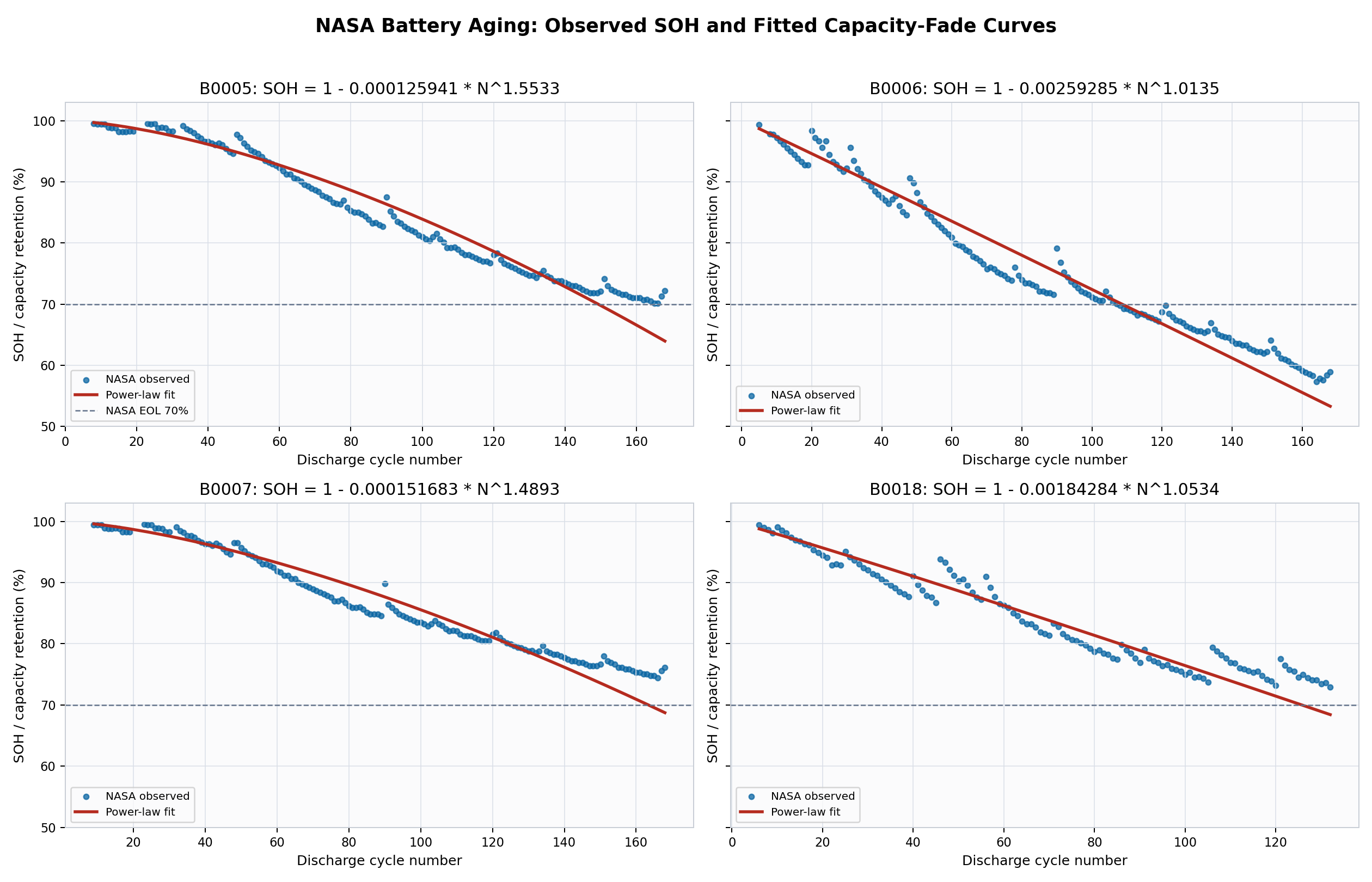
A technical demonstrator combining a degradation model inspired by NASA battery ageing data with thermal reconstruction on publicly available real-driving EV data.
Transparent empirical capacity-fade model fitted to NASA cell ageing data.
Thermal model calibrated on public real-driving EV measurements.
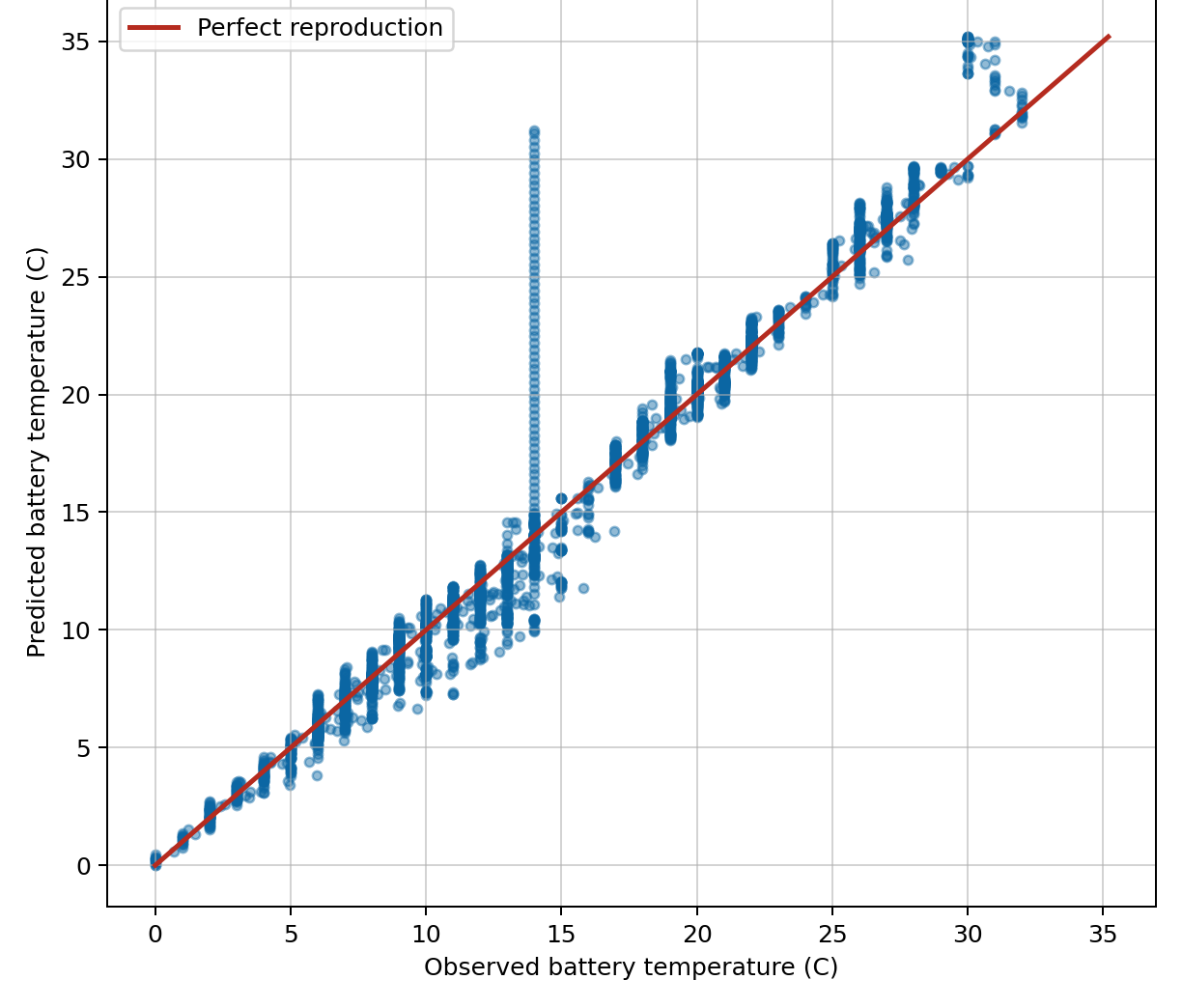
BlueMaat can combine cell ageing evidence and vehicle thermal behaviour in one modelling workflow, then translate battery-aware decisions into measurable stress reduction and asset-value preservation.
Data sources and references: B. Saha and K. Goebel, NASA Prognostics Center of Excellence Battery Data Set, NASA Ames, 2007; M. Steinsträter, J. Buberger and D. Trifonov, Battery and Heating Data in Real Driving Cycles, IEEE DataPort, 2020, DOI 10.21227/6JR9-5235; BlueMaat model development and performance metrics. Public datasets are used for technical validation only; no vehicle manufacturer affiliation, collaboration or endorsement is implied.

BlueMaat© 2026